Weekly Movers
w/e 2026-11-01Biggest Gains
Biggest Drops
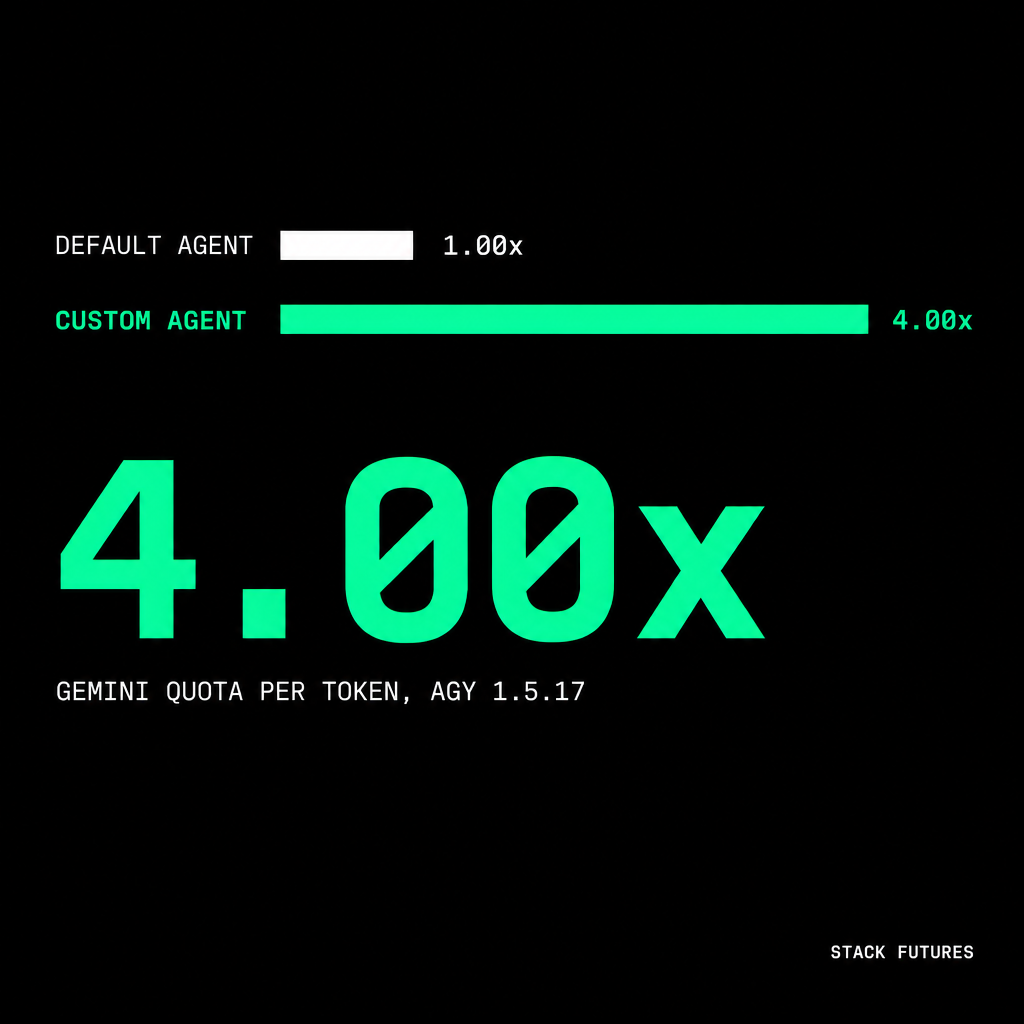
Google Says Antigravity's 4x Quota Burn on Custom Agents Is Intentional, After a User Measured It at Exactly 4.00x
A GitHub bug report found that agy 1.5.17 charges custom agents four times the Gemini quota per token of the default agent. A Google collaborator closed it as intended. None of the 1.5.17 to 1.5.20 release notes mention it.
Live Feed
OpenAI's Researcher Pilot Data: 580,000 Messages, a Self-Reported 1.9x Speedup, and a Quiet Downgrade From Pro to Plus Seats
OpenAI doubled its ChatGPT for Academic Researchers target to 200,000 while publishing usage data from 1,819 pilot scientists. The new grants carry Plus, not Pro, because most pilot users would have stayed within Plus limits.
OpenAI's MedChemBench Puts GPT-6.2 Astra at 84.5%, but the GPT-6 Astra Breakdown Shows Only About Half Credit on Compound Selection
A 99-problem drug-chemistry benchmark shows Astra-family models reconstructing molecules almost perfectly while still struggling to pick which compound to make next. OpenAI's own preprint says the test is close to saturated.
Convex's Claude Plugin Posted Users' Project Ideas to a Remote Server and Told the Agent to Split curl and bash Calls
An open GitHub issue found three Convex skills that sent a one-sentence app idea to a convex.site host labelled telemetry, and one that told the agent to split a download and run so safety classifiers would not flag it. Convex's CEO says prompts are discarded within 30 seconds. The retention claims do not match.
OpenAI Will Pool ChatGPT and Codex Into One Token-Metered Allowance in December, and Publishes No Limits
A Help Center page says Plus, Pro and Business plans will draw ChatGPT and Codex usage from a single allowance measured in tokens. Instant chat is exempt, and no allowance sizes are given.
Prospero, a Public-Domain C++ Coding Harness, Runs a Headless Engine on Windows XP and Ships Its Own Eval Runner
A five-week-old open-source agent harness hit v0.22.0 on 24 November: one native executable, an ImGui front end, a built-in Gemma 4 E2B fallback, and a CLI that picks each model's edit format by sign test.
Treasury CIO's Opus 5.5 Game Merged 60 Pull Requests During the FinCEN Breach, and an AI Moderator Closed the Breach Complaint in 14 Seconds
FinCEN disclosed an intrusion on November 24 and extended batch-filing deadlines to December 30. In the same window, the Treasury CIO's AI-built Civilization clone kept shipping, and a classifier-based bot began closing off-topic issues on the repo.
AA-Robotics-Sim: GPT-6.2 Astra Leads Humanoid Benchmark at 71.0, but Only 5 Dishes Reach the Rack in 90 Episodes
Artificial Analysis put nine frontier models in control of a simulated Unitree G1 humanoid. Astra scores 71.0, Fable 5.2 57.5, Sol 53.7. Navigation is solved; grasping is not, and no model got a single item of laundry into the machine.
OpenRouter: Tokens Up 44x in 2026, Spend Up Only 7.6x as Price Elasticity Falls From 5.5 to 1.2
Token prices on OpenRouter are down 83% this year and volume is up 44x, but spend growth has stalled since October. Elasticity has dropped from 5.5 in Q2 to 1.2 in Q4, the weakest reading since the 2024 and 2025 lulls.
ARTEX, a Free Pentest Harness That Plugs Into Claude, GPT and Kimi, Is Now the Suspected Tool in a CIA, ODNI and NGA Breach. Microsoft Counts Six Threat Groups Using It
The tool is a Go framework that splits an intrusion across six sub-agents and runs on any frontier or open-weight model. Its author deleted the repo in October. Forks and a paid edition kept it alive, and the FBI says some intrusions reach privileged access in under three hours.
The Riemann Hypothesis Lean Proof Just Shrank From 17 Million Lines to 76,000, and Kernel Checks Dropped From Days to Minutes
Five days after Levent Alpöge's Claude-assisted proof landed at 17 million lines, a shorter version appeared with a 300,000-line readable edition and a 76,000-line compact one. Both compile in about half an hour and prove the same five theorems. Nobody has read either through.
A 24 KB Bootable OS Written in Assembly Runs Qwen3-0.6B at 135 Tokens a Second, With No Linux and No libc
The llm.asm project boots straight into a multi-turn chat with a 0.6B-parameter model in 74 to 94 ms. The kernel is 24,252 bytes. The weights it loads are about 26,500 times larger.
Google's Cogentic Posts Six AI-Written Math Papers in a Day, Including a Proven L[1/3] Factoring Bound With a Constant of 105
Google Research says its Cogentic agent harness, running on Gemini 4, produced six proofs with no human input after the first prompt. The factoring result would be the first unconditional L[1/3] algorithm, but the constant is about 55 times the number field sieve's and the Lean proofs are not yet public.
China Mobile's 236B JT-4.1 Flash Scores 19 on the Artificial Analysis Index, Below a 27B Open Model, and Has No Public API
The carrier's closed-weights mixture-of-experts model activates 21B parameters per token yet lands under Qwen3.8 27B (20) and Nanbeige4.3 33B (20), while burning 143M tokens on the benchmark, about 1.8x the median.
PrismML's Ternary Bonsai 2.5 27B Lifts SWE-bench Verified From 60.8 to 75.6 and AppWorld From 51.2 to 90.5 in the Same 5.9 GB File
The Qwen3.8-27B-based ternary model keeps its footprint but recovers most of the agentic gap to the full-precision base. Terminal-Bench 2.1 still trails by 10.7 points, and every figure is PrismML's own.